- Study
- Student
- Research
- About UNAK
- University
- Schools & faculties
- Governance
- Rector
- University Council
- University Assembly
- Laws and regulations
- Organization
- Councils and committees
- Strategies & policies
- On campus
- Human resource
23. October 2025
An Economist with a Polar Perspective
Our Scientist of the Month: Joan Nymand Larsen
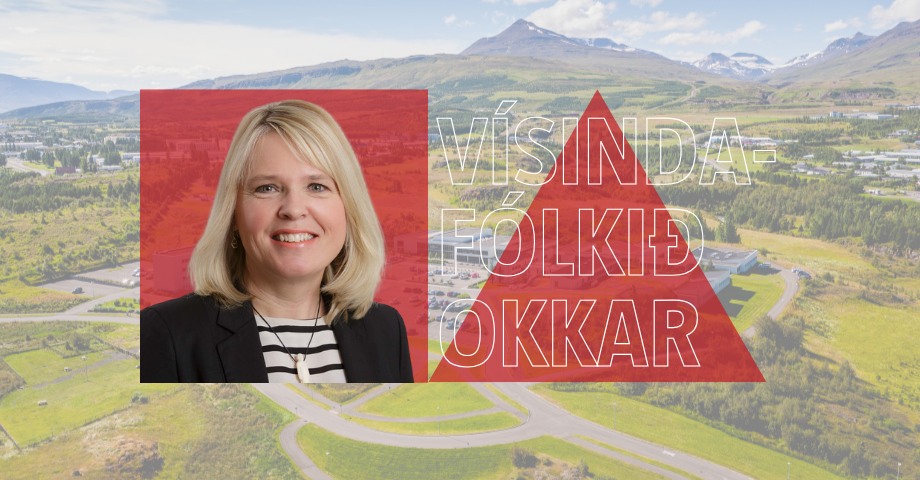
Our Scientists is a monthly feature where we introduce the researchers of the University of Akureyri. For the month of October, we present Professor Joan Nymand Larsen from the Faculty of Social Sciences.
Has lived in three Continents
Born in Odense, Denmark, and raised among the islands of South Funen, Joan Nymand Larsen seemed destined for a life shaped by the sea and the north. “I also spent part of my childhood in Greenland — in Maniitsoq and Nanortalik — where my teacher would sometimes let us leave class to watch when local hunters brought in a whale or a polar bear,” she recalls with a smile. Those early experiences in Arctic environments would later become the foundation for a lifelong academic journey dedicated to understanding life and change in the North.
After finishing high school in Svendborg, Joan took a detour that few economists can claim — all the way to rural Australia. “I went to Victoria on an agricultural exchange and worked with cows, crops, and farm holiday guests. It was what you might call experimental farming at best,” she laughs. The adventure eventually brought her back to Denmark, where she began studying economics at the University of Copenhagen. But soon, her path veered westward — this time to Canada, where she completed her PhD at the University of Manitoba, specializing in northern economic development.
“I spent 16 years in Canada — first as a student, then teaching and doing research at University of Manitoba. Later I even joined a negotiation team in a major union headquarters,” she says. But fate — and an Icelander — had other plans. “After I discovered Iceland and Jón Haukur who later became my husband, there was no turning back.”
Today, Joan is Professor of Economics and Arctic Studies at the University of Akureyri, and Senior Scientist and Research Director at the Stefansson Arctic Institute (SAI). She also holds an adjunct professorship at the University of Greenland (Ilisimatusarfik). Her academic life, much like her early childhood, is deeply tied to the Arctic and the people who live there.
Teaching with a NorthernTwist
At UNAK, Joan teaches economic theory, economic development, and a graduate course on the challenges of Arctic development. “The most fun thing about teaching,” she says, “is when students surprise you — when they share personal experiences or insights that turn a discussion in a new and unexpected direction.”
Her teaching philosophy is grounded in connection and curiosity. She often weaves real-world Arctic examples into her lectures, drawing on decades of fieldwork in Greenland, Iceland, and other northern communities. “Students bring their own perspectives and local experiences into the classroom — and that makes the learning dynamic and inspiring.”
Research inthe Arctic: Interdisciplinary and Deeply Human
Joan describes herself first and foremost as “an economist specializing in economic and sustainable development in the Arctic.” Her work explores the social and economic impacts of climate change, the adaptation strategies of local communities, and how to assess living standards and quality of life across the North.
“The Arctic is complex — and that complexity demands an interdisciplinary approach,” she explains. “We study the connections between environment, society, and economy, and how change in one affects all the others.”
Her fieldwork has taken her from Greenland to Iceland, Canada, Alaska, Svalbard, and across the Nordic Arctic. Much of it involves close cooperation with local residents and international research teams. “Interdisciplinary science and co-production with local stakeholders help us create a more holistic and accurate picture of reality,” she says. “And that allows us to work together with communities to find meaningful solutions.”
Joan’s current projects are as wide-ranging as they are impactful. She leads and contributes to large EU- and NordForsk and SSHRC-funded research initiatives on topics such as pollution and resilience in Arctic communities (e.g. ICEBERG), permafrost thaw, infrastructure risks, and cultural ecosystem services (ILLUQ, and Mapping Memories), and marine environments and food insecurity in Greenland (SustainME), and social and economic inequalities in South Greenland (e.g. WAGE).
“Our interdisciplinary approach is essential,” she emphasizes. “For instance, permafrost thaw affects housing, roads, health, and local economies — but these have traditionally been studied in isolation. We’re connecting the dots to understand the full picture.”
Her work has also been central to the Arctic Human Development Report (AHDR) series, which began during the Icelandic Chairmanship of the Arctic Council. “My first assignment when I came to Iceland was to coordinate the first AHDR — a baseline report that became a critical piece of work for both education and priority setting in the Arctic Council. Now we’re preparing the third report”
Life Beyond the Data
Despite her busy international research schedule, Joan finds peace in nature — preferably near the sea. “My husband and I have a second home in South Funen, by the coast and forest. It’s where we relax, go birdwatching, and do some healthy island bicycling — though, truth be told, a lot of time is spent pruning bushes and trees,” she says with a grin.
Her connection to the Arctic remains personal as much as professional. “If you plan to do research in Greenland,” she advises, “get familiar with the environment — and never plan important meetings right after your scheduled arrival. Weather delays are not an exception but a rule!”
After a lifetime of Arctic journeys — from childhood in Nanortalik to global climate panels — Joan remains as curious and passionate as ever. “It’s a privilege to work closely with communities and young researchers to understand and help shape the future of the Arctic,” she says. “And the Arctic never ceases to surprise you.”