- Study
- Student
- Research
- About UNAK
- University
- Schools & faculties
- Governance
- Rector
- Rector’s Office
- University Council
- University Assembly
- University Office
- Laws and regulations
- Organization
- Code of Ethics
- Councils and committees
- Strategies & policies
- On campus
- Human resource
9. December 2025
Author royalties donated to charity
The first book in the series Philosophical Fragments has now been published
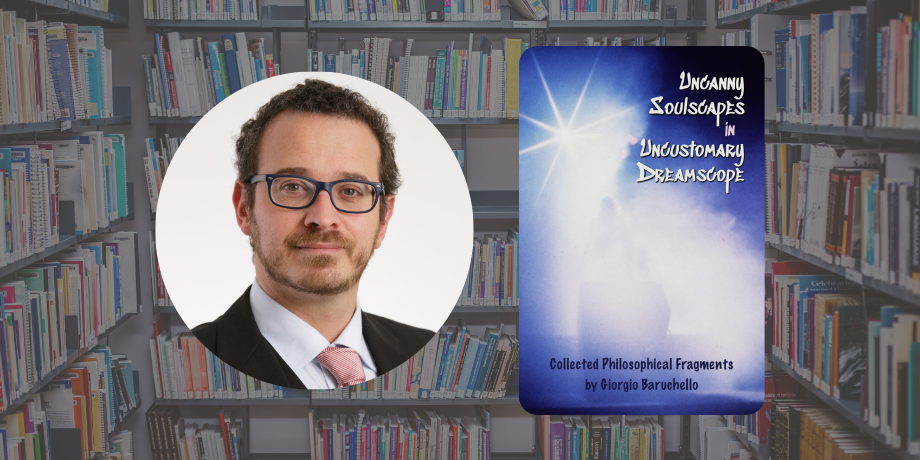
It was reported on the University’s website in April that a five-book series by Giorgio Baruchello, professor at The Faculty of Social Science at the university, was forthcoming. The first volume is now available on Amazon.
The books are philosophical works of, primarily, satirical literature and intellectual comedy, and are published by Northwest Passage Books in Canada. Giorgio lived in Guelph, Ontario, Canada during his PhD studies, and it is worth noting that he donates all of his author royalties to charitable organizations in that city.
With the first book now released, the remaining volumes will be published through 2027. The series includes a range of texts—comedies, satires, short stories, and novellas. The style is chiefly humorous and light, while also engaging with much more serious and grownup issues, particularly how humour is connected to cruelty in the contemporary world and human life at large. Giorgio’s style has been compared to Plautus, Leacock, Beckett, Ionesco, the Goons, Queneau, McLean, and Umberto Eco. The main aim is to let the readers think, yet without instructing them what to think, i.e., without preaching or reducing the plurality of conceivable viewpoints.
In the new series‘ background stand Giorgio‘s numerous philosophical inquiries since the 1990s into nature- and human-made cruelty, including the four-volume scholarly and socio-scientific series Humour and Cruelty (Berlin: De Gruyter, 2022–2024), co-authored with prof. Ársæll Már Arnarsson, a biological psychologist at the University of Iceland.
Each book will have a distinctive visual design, featuring original covers adorned with artworks by well-known international photographers—including Armando Gallo, Alberto Terrile, Agata Wilczyńska, and Veronika Korchak.
A review - philosophical comic genius
It is a pleasure to report that Richard Proust, Emeritus Professor of Philosophy at St. Andrews University in North Carolina, has published his assessment of the book.
The review praises Baruchello’s book as a rare and successful integration of philosophical rigor and genuine humor, suggesting that it may represent the work of a philosophical comic genius coming fully into his own. It argues that the book demonstrates how laughter can disclose truths inaccessible to purely serious discourse, making humor an essential mode of understanding rather than a distraction from truth.
Through inventive essays, playful rhetoric, and abundant examples, one where Baruchello reveals something hilarious about the academic world and with that opens new paths for philosophical reflection on humor. Overall, Dr. Proust presents the work as an original, intellectually ambitious, and consistently funny contribution to philosophy and humor studies.
More reviews of the book have since appeared, and here is an excerpt from one of them: “I am a kid of the growing up with algorithms generation...This book can be enjoyed by most! The stories themselves are worth reading; with or without reading into them. But if you choose to read into them, another dimension is opened for reflection, feeling and thought.”
Another reader praises the book, and the first sentence of that review reads: “This book is a wonderland of the uncanny, rich delights.”
Yet another reader offers insight into the relationship between humor and cruelty, which is one of the book’s central themes: “Baruchello does not treat these concepts abstractly; he brings them to life. He embodies them in figures that are often caricatured—some repellent, others painfully recognizable. The laughter that runs through many pages is never consoling; it is a laughter that exposes, unmasks, unsettles.”
All reviews can be found on Goodreads.com and Amazon.com.