- Study
- Student
- Research
- About UNAK
- University
- Schools & faculties
- Governance
- Rector
- University Council
- University Assembly
- Laws and regulations
- Organization
- Councils and committees
- Strategies & policies
- On campus
- Human resource
10. August 2026
Icelandic Highlands Offer Clues to Ancient Life on Mars
Successful research expedition
Around four billion years ago, Mars was a very different planet. Liquid water flowed across its surface, its atmosphere was much thicker than it is today, and a magnetic field helped protect the planet from harmful radiation and the loss of its atmosphere. These conditions raise an intriguing question: could early Mars have supported life—perhaps even diverse communities of microorganisms—while Earth itself was still young?
Important evidence for ancient water on Mars comes from minerals known as phyllosilicates, or clay minerals. They form when volcanic rocks are altered through prolonged contact with water. In 2005, measurements from an infrared spectrometer aboard the European Space Agency’s Mars Express spacecraft confirmed the presence of these minerals in Syrtis Major and other parts of Mars (Poulet et al. 2005). This discovery provided some of the clearest evidence that substantial amounts of water once existed on the Martian surface.
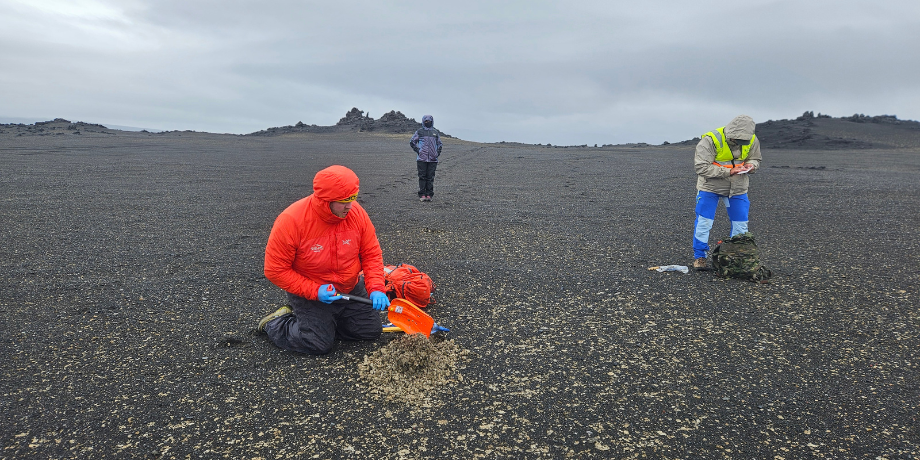
The University of Akureyri is taking part in Mars-GH, a research project funded by the Spanish Ministry of Science, Innovation and Higher Education. The project examines the microbial communities found in dried-up lakes in the Icelandic Highlands, the composition of the clay deposits, and signs of microbial activity preserved within them. By studying these environments, researchers hope to improve our understanding of where and how evidence of ancient life might be found on Mars.
How Mars and Iceland are alike
Some landscapes in Iceland offer a useful comparison with these ancient Martian environments. Sprengisandur in the Central Highlands is perhaps the most striking example. Jón Sigurðsson frá Yztafelli described it in 1954 as:
“An incredibly varied wasteland. Smooth, rounded gravel ridges follow one another, with neither a mountain nor a hill in sight—thousands of square kilometres with the same appearance. […] Here, it is as though time has stood still, while century after century has passed over the land without purpose or footsteps.”
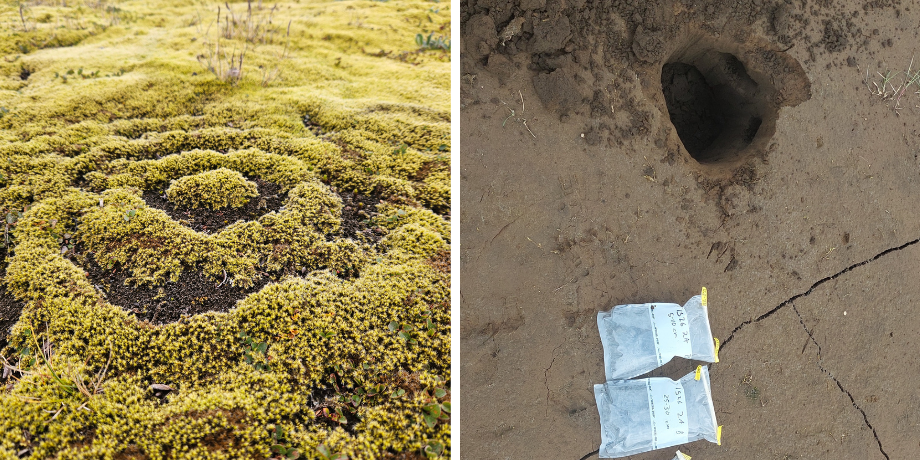
Although the region appears almost entirely barren, small lakes and ponds are scattered across the landscape. Many are filled by melting snow and dry out completely by late summer, leaving exposed lakebeds that are shaped by the wind. Where water comes into contact with basaltic rock, clay minerals similar to those found on Mars can form. Despite the harsh conditions, microorganisms are also able to survive in these environments.
UNAK´s expedition
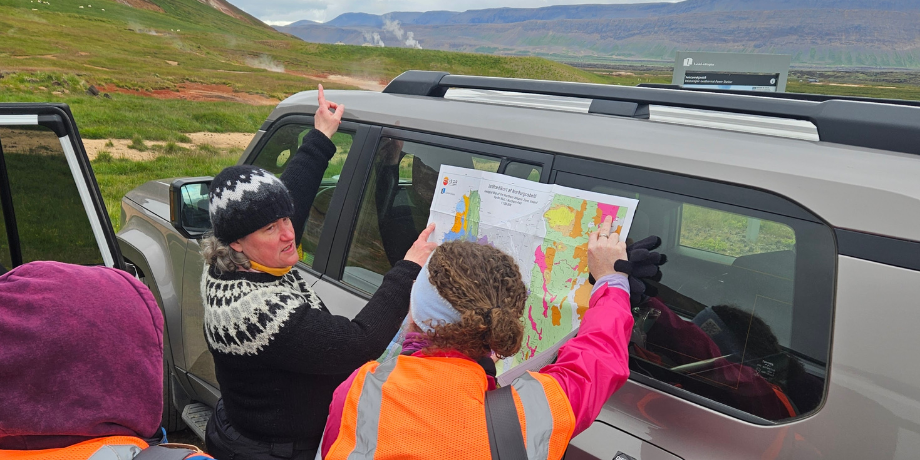
From 27 July to 2 August, Javier Huertas, Andrés Tryggvi Jakobsson, Oddur Þór Vilhelmsson, Anett Blischke, Amanda Stockton and Marina Caeiro carried out a successful research and sampling expedition for the project.
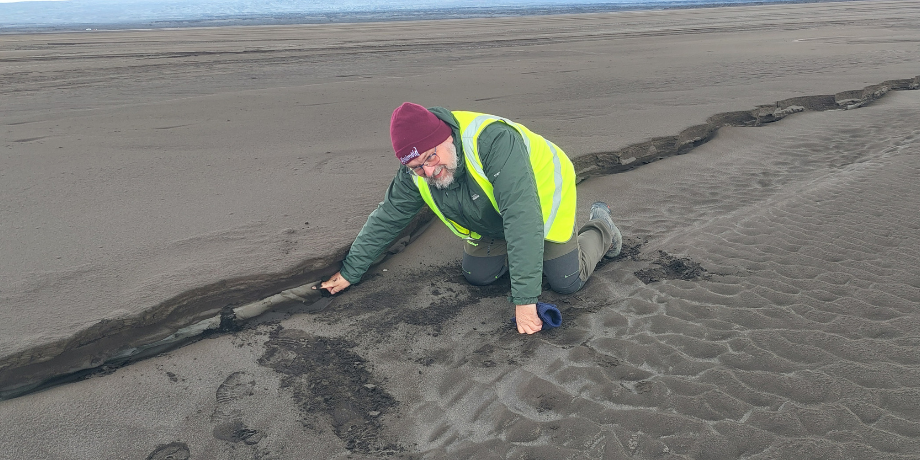
The team surveyed dried-up ponds and other clay-rich sites across Northeast Iceland and the Central Highlands, including Öxarfjarðarheiði, Fjöll, Vikrasandur, Flæðir and Sprengisandur. The samples and data collected during the expedition will be analysed over the coming weeks and months.
The research was made possible with the kind permission and assistance of Vatnajökull National Park, the National Energy Authority of Iceland, ÍSOR, Landsvirkjun, and the residents of Sandfell and Grímsstaðir. The research team would also like to thank everyone who contributed to the expedition, including the Iceland Touring Association’s wardens at the Dreki and Nýidalur huts.
References
- Poulet, F.,Bibring, J.P., Mustard, J. et al. 2005. Phyllosilicates on Mars and implications for early martian climate. Nature 438, 623–627 (2005). https://doi.org/10.1038/nature04274
- Jón Sigurðsson fromYztafell. 1954.South Þingeyjasýsla. Ritsafn Þingeyinga 2, 383 pp. Helgafell, Reykjavík.