- Study
- Student
- Research
- About UNAK
- University
- Schools & faculties
- Governance
- Rector
- Rector’s Office
- University Council
- University Assembly
- University Office
- Laws and regulations
- Organization
- Code of Ethics
- Councils and committees
- Strategies & policies
- On campus
- Human resource
27. November 2025
Liturature loving psychologist
Our scientist of the month: Hilal Sen
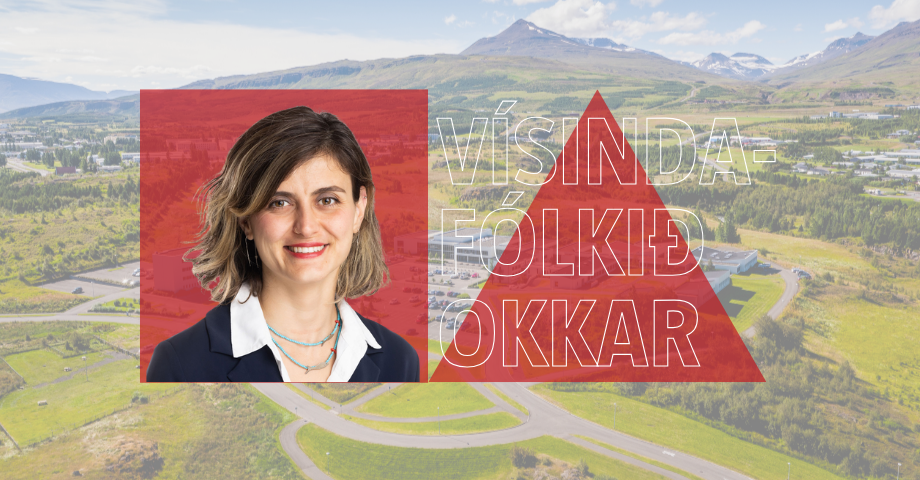
Our Scientists is a monthly feature where we introduce the researchers of the University of Akureyri. For the month of November, we present Associate Professor Hilal Sen from the Faculty of Psychology.
When developmental psychologist Hilal Sen moved from a city of 20 million to a town of 20,000, she was more than ready for a change of pace. “I am one of the privileged people who still gets to do the job I love, in a place I am happy to call home and where I continue to study one of humanity’s most fascinating topics: how we grow, learn, and become who we are,” she says, smiling.
From the Black Sea to the Arctic Circle
Hilal was born in Trabzon, a windy coastal city in the northeastern corner of Turkey, near the Georgian border. “The weather there changes every five minutes — maybe that’s why I adapted to Iceland so easily,” she laughs. Because of her father’s job, Hilal’s childhood was nomadic: Trabzon in the northeast, Edirne in the northwest, Istanbul straddling Europe and Asia, and then the sun-soaked coasts of Izmir and Antalya.
“Moving all the time made me feel disconnected as a child,” she reflects, “but later I realized it taught me flexibility and how to create a sense of belonging wherever I go.”
She studied psychology in Ankara, at one of Turkey’s most active and politically engaged universities. Initially set on becoming a clinical child psychologist, Hilal’s path took a turn after a powerful moment during an internship. “I was meeting a grandmother who told me a tragic story, and I couldn’t stop crying with her,” she recalls. “That’s when I realized I didn’t want to work in clinical settings. I wanted to study children, but in a way that suited me better.”
That realization led her to Koç University in Istanbul, where she earned her master’s and PhD in developmental psychology. In 2022, after years of teaching and research in Istanbul, Hilal made the leap northward — to the University of Akureyri.
It wasn’t a random choice. “When I was in high school, I saw Dancer in the Dark at a small film festival in İzmir,” she says. “I was deeply moved — especially by Björk. I started reading everything about her and Iceland. I remember thinking, ‘One day I’ll go live there.’ Apparently, I wasn’t just thinking it!”
Turning Psychology into Everyday Life through teaching
At the University of Akureyri, Hilal teaches Developmental Psychology, Adult Psychology, and Educational Psychology — courses that explore the many stages of human growth. She takes pride in connecting theory with real life. “I love making connections between what I teach and what I see in daily life. Sometimes I see a sentence on a poster in town and think, ‘Ah! That’s a perfect example for next week’s lecture!’”
Hilal believes teaching should be alive and relatable. “Teaching well is really important to me, and I truly enjoy it. I love making connections between what I teach and what I see in daily life — sometimes I am just walking on the street, I see a sentence on a poster, and I think, “Ah! This is a perfect example for that topic we discussed in class.” Building this bridge between everyday life and the course content gives me a lot of joy. It takes effort, of course, especially when I am teaching a very technical topic. But I really enjoy bringing psychology theories to life through movies, documentaries, novels, or things from popular culture. I actually spend time thinking about how to do this and have a special note folder where I keep taking notes of “use this material when you teach this topic”
She admits she also learned a lot from “how not to teach.” “During my student years, I saw many teachers who had lost their passion,” she says. “So, I always ask myself: what kind of teacher do I not want to be?”
For Hilal, the joy of teaching often arrives in small, unexpected moments. “Sometimes, a former student stops me and says, ‘I took your course years ago — it meant a lot to me.’ That’s the kind of feedback that makes me go to bed with a peaceful heart.”
Still, not everything is easy. “Some students expect everything to be simple, pre-digested, and ready-to-use,” she notes. “University isn’t supposed to be like that. It’s about learning how to think deeply and critically, to read widely, and to manage uncertainty.”
Her suggestion? “Every university should have an ‘Introduction to Academic Life’ program for first-year students — it would make learning healthier for both students and instructors.”
Children’s Morality, Curiosity, and Inequality
As a developmental psychologist, Hilal studies how humans change across the lifespan — but her main focus is childhood, especially ages 0–12. “I group my work into two main areas,” she explains. “The first is moral development — how children judge right and wrong, how they help others, when they lie, and how they think about fairness.”
Her second major research area is children’s curiosity and exploration. “We know children are naturally curious — but we still don’t fully understand what curiosity is for, or when children explore more or less,” she says. “I look at how attention, parenting, and culture shape these patterns.”
“In my field, the most urgent research topics often become visible when we look at the themes highlighted in recent conferences. For example, at the European Conference on Developmental Psychology in August 2025, two areas clearly stood out: discrimination and prejudice against immigrant children, and the socio-emotional difficulties faced by refugee children. These priorities show us what developmental scientists across Europe are most concerned about right now, and it is quite understandable why these issues require immediate attention.
But I would also like to add another topic that I find extremely important — also important in the Icelandic context: the growing income inequality and the widening differences in socio-economic status. In other words, increasing poverty — particularly child poverty. For children, poverty is not only about having fewer material resources. It also means higher levels of family stress, fewer opportunities for exploration and learning, and reduced access to supportive environments.” Hilal explains and adds, “as developmental psychologists, we know that early environments shape children’s long-term outcomes. Still, we need much more research to understand how socio-economic disadvantages affect different aspects of development, and which protective factors help children thrive despite these challenges.
For her, the message is clear: “These trends call for evidence-based action. Developmental science can guide social policy to ensure that all children — regardless of background — can thrive.”
Postpones to finish a good book
When she’s not teaching or researching, Hilal immerses herself in books. “I’m a complete literature lover,” she admits. “If I love a book, I feel sad when it ends — sometimes I even postpone reading the last pages.” Her favorite author is José Saramago, and she proudly owns a growing collection of world literature.
“I am also quite theatrical, I love acting, feeling a character, and doing impressions.” says Hilal with a smile as we say goodbye, she maybe on her way with her husband and child to the Lystigarður or to take a seat at a caffee reading on of her books.