- Study
- Student
- Research
- About UNAK
- University
- Schools & faculties
- Governance
- Rector
- University Council
- University Assembly
- Laws and regulations
- Organization
- Councils and committees
- Strategies & policies
- On campus
- Human resource
Doctoral Defence in Natural Resource Sciences
<span class="month"> 7</span>Oct <span class="time">at 10:00-13:00</span>
Ashani Arulananthan will defend her doctoral thesis
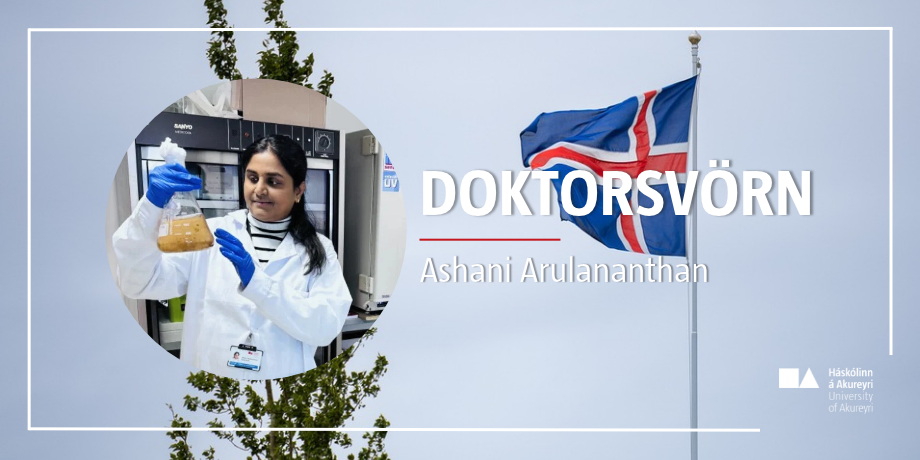
Wednesday 7th October, Ashani Arulananthan will defend her doctoral thesis in Natural Resource Sciences at the University of Akureyri.
The doctoral thesis is entitled: Per- and polyfluoroalkyl substances (PFASs) meet Arctic and sub-Arctic marine diatoms and associated symbionts.
- The thesis can be found here
- The defence will be held in English in the University’s Ceremonial Hall (Hátíðarsalur) at 10.00 and is open to the public
- Please confirm your attendance here
- The defence will be streamed here
The thesis work was supervised by Dr. Oddur Þór Vilhelmsson, Professor of Microbial Ecology, Molecular Biology, and Environmental Biotechnology, at the University of Akureyri, Dr. Bettina Scholz, specialized in Phycology and Chemical Ecology at BioPol ehf., Skagaströnd and Dr. Margrét Auður Sigurbjörnsdóttir, Associate Professor of Biotechnology at the University of Akureyri. In addition, the doctoral committee included Dr. Óttar Rolfsson, Professor of Biochemistry and Systems Biology at the University of Iceland (co-supervisor and secondment host), Dr. Hans-Peter Grossart, Professor of Aquatic Microbial Ecology and Biodiversity at the Potsdam University and Leibniz Institute of Freshwater Ecology and Inland Fisheries, Germany (co-supervisor and secondment host). Also the advisor, Dr. Ulf Karsten Professor of Applied Ecology and Phycology at the University of Rostock, Germany (Secondment host).
The doctoral project is funded by the Icelandic Research Fund awarded to Dr. Bettina Scholz.
The opponents are Dr. Peter G. Kroth, Professor of Plant Physiology at the University of Konstanz, Germany, and Dr. Angela Wulff, Professor of Marine Biology at the University of Gothenburg, Sweden.
Dr. Guðrún Rósa Þórsteinsdóttir head of the Division of Research and Doctoral Studies and Dr. Brynjar Karlsson, dean of the School of Health, Business and Natural Sciences will chair the ceremony.
About the Doctoral candidate
Originally from Sri Lanka, Ashani Arulananthan earned a BSc (Special) in Aquatic Resources Technology from Uva Wellassa University in 2013. Her undergraduate research examined the antimicrobial activity of seagrass from the southwest coast of Sri Lanka. She subsequently completed an MPhil. in Biotechnology at the University of Peradeniya in 2020, investigating coral-reef status and the genetic diversity of selected coral species in the Jaffna Peninsula and its major islands. This research contributed to the confirmation of 36 coral species not previously recorded in Sri Lanka.
From 2018 to 2021, Ashani worked as an assistant marine environmental officer at the Marine Environment Protection Authority, Sri Lanka. She later joined Aalborg University in Denmark as a research assistant on the JPI Oceans FACTS project, where she analyzed North Sea water samples for microplastics using micro-FTIR spectroscopy.
In 2023, Ashani began her PhD studies in Natural Resource Sciences at the University of Akureyri, Iceland. Her doctoral research investigates how per- and polyfluoroalkyl substances (PFAS) affect Arctic and sub-Arctic marine diatoms and their associated bacterial communities. By combining controlled exposure experiments with measurements of growth, photosynthetic performance and cellular stress, as well as metabolomics, full-length transcriptomics and microbiome profiling, her work examines PFAS effects across multiple levels of biological organization in marine model diatoms.
During her PhD, Ashani undertook Erasmus+ research visits at Leibniz-IGB, the universities of Rostock and Oldenburg in Germany, and the University of Las Palmas de Gran Canaria in Spain. Most recently, she conducted an Erasmus+ research traineeship at the Spanish Bank of Algae, University of Las Palmas de Gran Canaria, where she expanded her PFAS research to additional marine microalgae and cyanobacteria. Her broader interests include marine microbial ecology, ecotoxicology, microalgae-microbiome interactions, coral reefs, emerging contaminants and the effects of environmental change on aquatic ecosystems.
Abstract
Per- and polyfluoroalkyl substances (PFAS) are persistent contaminants detected globally, including in polar environments. Their occurrence raises concern for diatoms, which contribute approximately 20% of global primary production and support aquatic food webs. This thesis investigated PFAS responses in two contrasting marine diatom strains: the pennate, sediment-isolated Cylindrotheca closterium and the centric, plankton-associated Thalassiosira pseudonana. Physiological responses were examined following 10-day exposure to individual PFAS and mixtures across a broad nominal concentration range. A 28-day exposure to a six-compound mixture at 0.9 ng/L per compound (5.4 ng/L combined nominal) was subsequently used to investigate temporal physiology, targeted endometabolomic and PacBio Iso-Seq transcriptomic patterns, and phycosphere bacterial communities. Short-term exposure produced the clearest growth inhibition and disruption of photosynthetic and biochemical endpoints at 1 and 100 mg/L. Mixtures frequently caused greater inhibition than selected individual treatments, although formal synergy was not tested. Responses differed between the strains and included reduced PSII efficiency, chlorophyll and protein, together with elevated proline and total antioxidant capacity. During prolonged low-level exposure, growth estimates converged towards control values after approximately 14 days, consistent with compensation or acclimation rather than demonstrated recovery or adaptation. Exploratory molecular profiles indicated broader photosynthetic, carbon, nitrogen and lipid-associated reorganization in T. pseudonana, whereas C. closterium exhibited more focused transporter-, proline- and central-carbon-associated patterns. These responses represent candidate mechanisms because biological replication of the omics comparison was limited. In the separately replicated microbiome experiment, host identity significantly structured bacterial communities, while PFAS treatment did not significantly affect alpha diversity or whole-community composition. Nevertheless, selected taxa showed treatment-associated relative-abundance patterns. Overall, the thesis demonstrates the value of integrating physiological, molecular and microbiome endpoints to identify sublethal PFAS-associated responses that growth measurements alone may not reveal. The results provide testable hypotheses but do not establish broad species-level patterns or ecosystem-scale consequences.
All welcome!