- Study
- Student
- Research
- About UNAK
- University
- Schools & faculties
- Governance
- Rector
- Rector’s Office
- University Council
- University Assembly
- University Office
- Laws and regulations
- Organization
- Code of Ethics
- Councils and committees
- Strategies & policies
- On campus
- Human resource
Doctoral Defence in Natural Resource Sciences
27. March 2026 at 09:00-13:00
Theodore E. Squires will defend his doctoral thesis
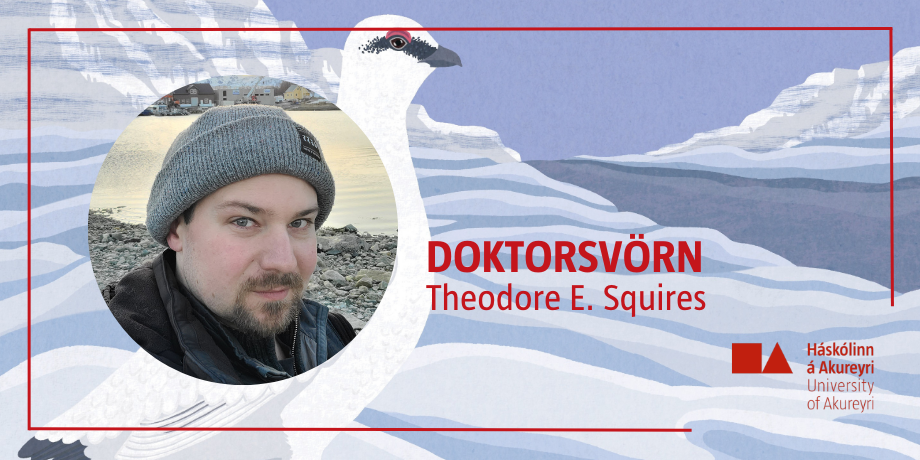
Friday, March 27, Theodore E. Squires will defend his doctoral thesis in Natural Resource Sciences at the University of Akureyri. The doctoral thesis is entitled: Evolutionary ecogenomics of North Atlantic ptarmigan.
The defence will be held in English in the University‘s Ceremonial Hall (Hátíðarsalur) in Akureyri at 09:00 and is open to the public.
Please confirm your attendance here
The thesis work was supervised by Dr. Kristinn Pétur Magnússon, Professor of Molecular Genetics at University of Akureyri, Dr. Jacob Höglund, Professor of Animal Conservation Biology at Uppsala University, Sweden. In addition, the doctoral committee included Dr. Eva Halapi, Associated Professor of Microbiology and Immunology at UNAK, Dr. Snæbjörn Pálsson, Professor of Population Biology at University of Iceland, and Dr. Jennifer Forbey, Professor of Biology at Boise State University, USA and Dr Patrik Rödin-Mörch, Bioinformatician Uppsala Genome Center, Uppsala, Sweden.
The doctoral project is a part of “Ptarmigan Ecogenomics”, a project funded by the Icelandic Research Fund (Rannís grant no. 206529-051) awarded to Kristinn P. Magnússon. Additional funding was awarded to Jacob Höglund by the Swedish Research Council (Vetenskapsrådet; VR grant no. 2018-04635). Work carried out at NGI/Uppsala Genome Center was supported by both the Swedish Research Council and Science for Life Laboratory, Sweden. Finally, the project also received support from the University of Akureyri Research Fund.
The opponents are Scott V. Edwards Alexander Agassiz Professor of Organismic and Evolutionary Biology Curator of Ornithology, Museum of Comparative Zoology, Harvard University and Arnar Pálsson Professor at Faculty of Life and Environmental Science, University of Iceland.
Dr. Guðrún Rósa Þórsteinsdóttir, Director of the Centre for Doctoral Studies, and Dr. Brynjar Karlsson, Dean of the School of Health, Business and Natural Sciences will chair the ceremony.
About the Doctoral candidate
Born in Seattle in 1992, Theodore Squires followed his passion for nature by earning a bachelor's degree in Fisheries and Wildlife Science from Oregon State University in the United States in 2015. He then advanced by completing an MSc in Environmental Resources at Hokkaido University of Sapporo, Japan in 2017. In June 2021, Theodore commenced his PhD studies in Natural Resource Sciences at the University of Akureyri, Iceland. The following year he was accepted to expand his studies as part of a dual-degree arrangement from Uppsala University in Sweden where he currently resides.
Theodore first came to Iceland as a volunteer in Dr. Ólafur Karl Nielsen’s ptarmigan lab at the Natural Science Institute of Iceland in 2014. He has since returned many times and shows interest in continuing collaborations and development of research projects with Icelandic scientific community.
Since beginning his doctoral research he has been a lead teacher for marine field courses on the Swedish west coast, covered graduate-level conservation courses in Uppsala, and has assisted with Genetics lectures at University of Akureyri. He received accreditation for academic teaching in Sweden in 2026.
Over the course of his studies he organized field work and attended conferences in Iceland, Sweden, Norway, the United States, Mexico, Spain, Andorra, and Scotland. This included among other activities collecting ptarmigan feathers in the Pyrenees with support from the Andorran government, gathering tissue samples from captive breeding facilities in the Arctic at University of Tromsø, and sharing collaborator’s work as a presenting member of the Icelandic Biological Society in Reykjavik.
Abstract
This PhD research investigates how ptarmigan across the North Atlantic adapt to rapidly changing environments by integrating ecology, population genomics, and long term monitoring. The work begins with the development of a high quality chromosome level reference genome for the Rock Ptarmigan (Lagopus muta), enabling detailed functional and comparative analyses. Using whole genome resequencing of almost a hundred individuals from nine countries, the thesis shows that climate associated adaptation in ptarmigan is strongly polygenic and that forecasts of future vulnerability depend heavily on the climate models used. A temporal dataset of 91 Icelandic juveniles collected over 11 years reveals widespread allele frequency oscillations aligned with multi annual population cycles, with many fluctuating loci linked to neurological, behavioral, and immune pathways—patterns consistent with density dependent selection. An exploratory genome wide association study of condition traits (fat, size, weight) further supports a highly polygenic architecture, while highlighting plausible candidate genes for future study. Together, the findings from this thesis provide new genomic resources, demonstrate how ecological dynamics shape evolutionary change, and offer practical guidance for conservation planning under accelerating environmental change.
Keywords: Ecology, Genomics, Ptarmigan, Conservation, Evolution, Biology
Everyone is welcome!