- Study
- Student
- Research
- About UNAK
- University
- Schools & faculties
- Governance
- Rector
- Rector’s Office
- University Council
- University Assembly
- University Office
- Laws and regulations
- Organization
- Code of Ethics
- Councils and committees
- Strategies & policies
- On campus
- Human resource
5. December 2025
A year in review: EMERG group’s work
The Environmental Biotechnology and Microbial Ecology Research Group (EMERG)
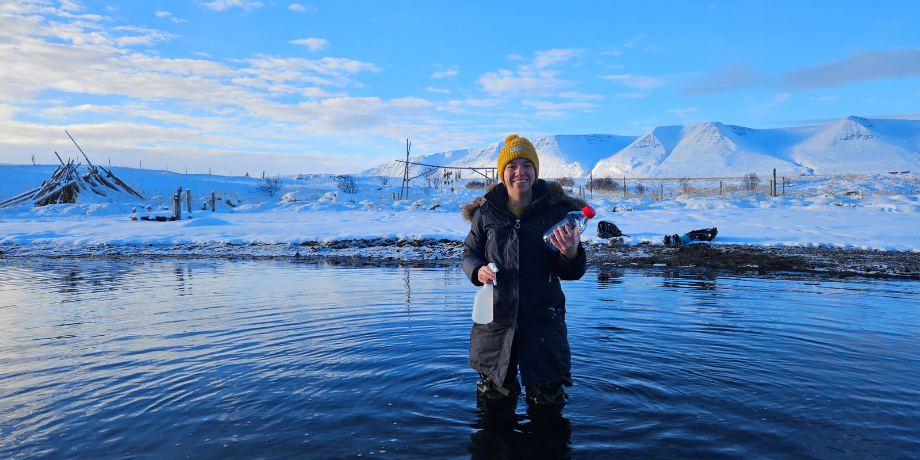
There's been “much ado about science" in EMERG this year, so despite the difficulties of a mould-infested building, our research has gone remarkably well. Thus, the group published three peer-reviewed articles during the year and presented research at five conferences and at Rannís Science Night, in addition to which the doctoral students went on research/training visits to Germany, France, and Italy, and field research was conducted on the Reykjanes Peninsula. Continued momentum is expected in the coming year, with the group convening sessions at two major international conferences, one in the Faroe Islands and the other in New Zealand, as well as working on further publications in peer-reviewed journals, and other research activity. The group is led by Auður Sigurbjörnsdóttir and Oddur Þór Vilhelmsson, faculty members in the Department of Natural Resource Sciences. You can read more about the year’s activities in individual projects below.
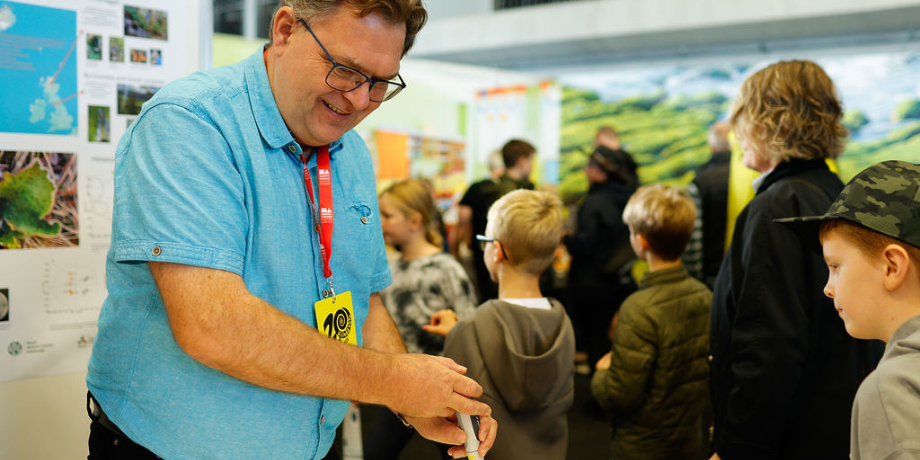
Oddur shows his work at Vísindavaka (Rannís Science night)
Projects managed by the group are diverse in nature, and a newsletter was compiled for the year providing more detailed information about the projects, grants, and progress. Below is a brief overview of the projects, and the full newsletter can be accessed here.
Lichens and algae
In the Psyringae project, Natalía Ramírez Carrera published an article with the main findings of experiments on the effects of secondary metabolites from lichens on the plant pathogen Pseudomonas syringae. The project’s final paper was published during the year, and the project concluded when Natalía defended her doctoral dissertation at the university last year. She now works as a postdoctoral researcher at the Swedish University of Agricultural Sciences in Malmö.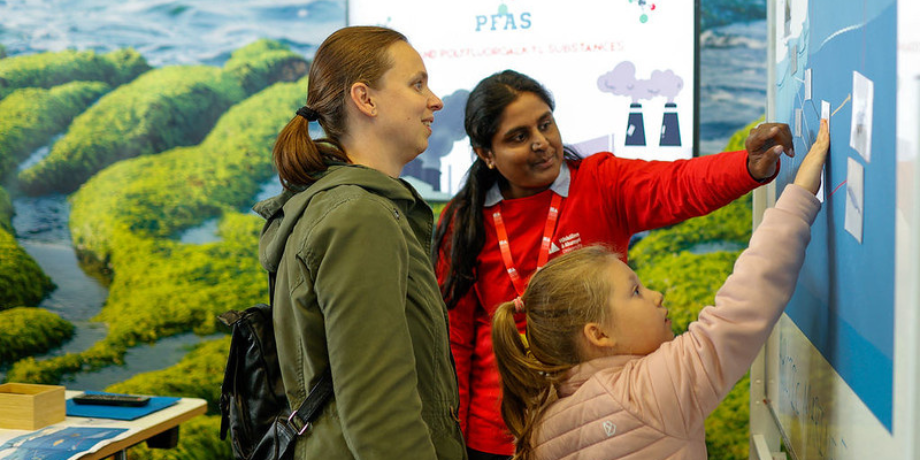
Ashani explaining her work at Vísindavaka (Science fair)
Two papers related to the PFAS project were published. The first paper reviews current knowledge on PFAS contamination in the Arctic, and the second paper presents the authors work on their effects on marine diatoms from Icelandic coastal environments. Ashani Arulananthan, a PhD student, is the lead author of both papers, and she has also presented the project widely this year, including at the SAME18 conference in Barcelona.
At the beginning of the year, Alexandra Georganti Ntaliape was hired as a PhD student in the Faculty of Natural Resource Sciences. She has been developing methods for screening algicidal bacteria and extracting DNA from algal blooms, and participated in training courses in Roscoff and Verbania. The project is conducted within the European research network PHABB and is part of the ParAqua consortium.
Soils on Earth and in outer space
Andrés Tryggvi Jakobsson, Project manager at the University’s research laboratories, is pursuing a master’s degree in biotechnology. His research focuses on analyzing microbial life in silica-rich sediments of dried-up lakes and riverbeds, with the aim to draw conclusions about the potential for life on Mars today and in the distant past. The project is titled Mars-GH. Andrés has conducted fieldwork for the project and presented it at the BEACON conference in Reykjavík.
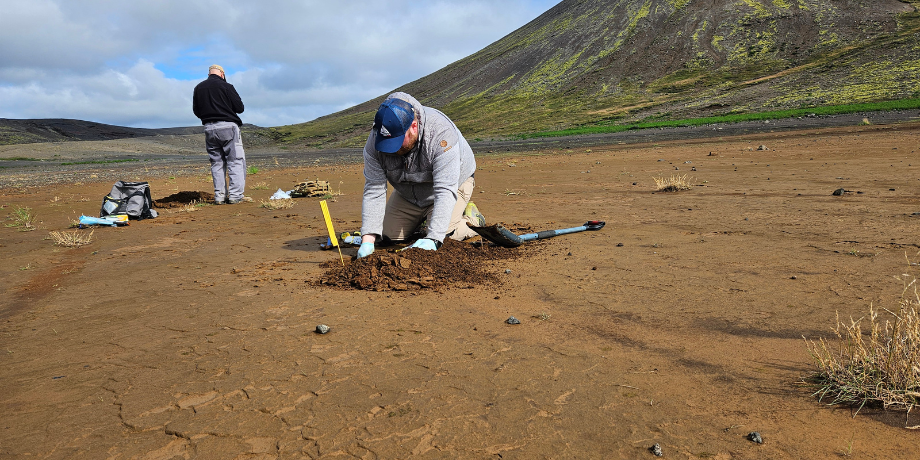
Andrés working on the MARS- GH Project
The final workshop of the project on Dog Lichens and the impacts of climate warming on their microbial communities took place during the year. A final report was also submitted, and a follow-up grant application to Horizon Europe has been prepared. Oddur presented the project at the Icelandic Biology Conference in Reykjavík and at the annual meeting of the French Phycological Society in Paris. The project was led by Robert Jackson at the University of Birmingham, together with Auður and Oddur.
Work has now begun on analyzing samples collected last year in Leirársveit to assess the impact of wetland restoration. This work is part of the ReWet project, and the plan is to hire Nicolas Martin, a postdoctoral researcher, to work on the project at the beginning of next year. The project is led by Bjarni Diðrik Sigurðsson, a professor at the Agricultural University of Iceland, while Auður supervises Nicolas’s part of the work.
Work has also restarted on a project that focuses on microorganisms in methane-seepage pockmarks in sediments at Austursandur in Öxarfjörður. Oluwafemi Solomon, a master’s student in biotechnology, will carry out his master’s thesis within this project and will be screening microorganisms for the degradation of hydrocarbons. Nicolas and Oddur will supervise the project.
Finally, BSc-students in biotechnology, completed individual projects within a metagenomics research initiative that concluded this year, supervised by Oddur and Auður.