- Study
- Student
- Research
- About UNAK
- University
- Schools & faculties
- Governance
- Rector
- University Council
- University Assembly
- Laws and regulations
- Organization
- Councils and committees
- Strategies & policies
- On campus
- Human resource
30. March 2026
UNAK Praised for Innovative Teaching of Roman Law
A New Intellectual Collaboration with the Faroe Islands
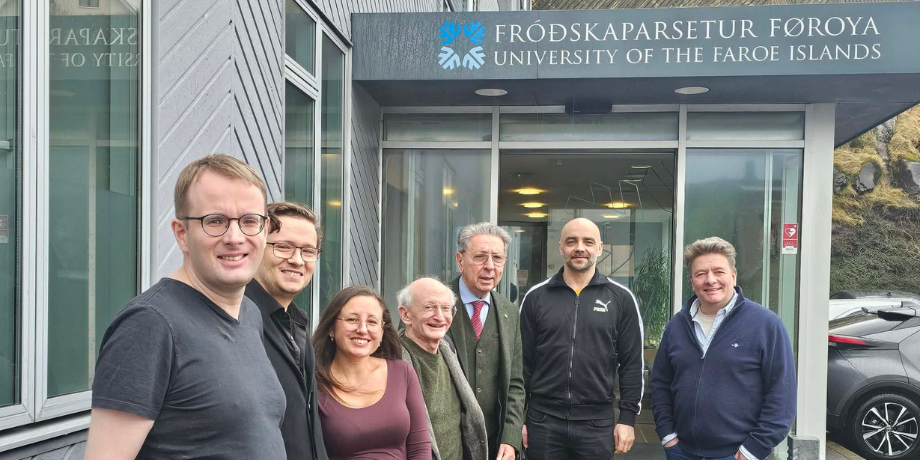
On 7 March, a symposium on Roman Law was held at the Faculty of History and Social Sciences of the University of the Faroe Islands, bringing together scholars to reflect on the enduring relevance of legal history in contemporary legal education. Among the invited speakers was Sara Fusco, Adjunct at the Faculty of Law of the University of Akureyri (UNAK), where she teaches Roman Law.
The symposium was organised to celebrate the appointment of Professor Francesco Millazzo as Affiliate Professor at the University of the Faroe Islands. Having taught there in 2020, 2022, and 2024, Professor Millazzo was formally appointed in October 2025 in recognition of the success of his teaching and his long-standing academic career as full professor at the University of Catania, as well as his broader international engagement, at UNAK as well.
In his lecture, Professor Millazzo reflected on the historical nature of law, observing that what we call the “present” is never self-sufficient, but always rooted in the past while shaping the future. From this perspective, Roman law stands out for its capacity to adapt across centuries to changing social and political conditions. He highlighted the central role of the Bolognese legal school from the 11th century onward in shaping a legal tradition that transcended political borders and can be understood as inherently European. Even with the rise, and later crisis, of codification, Roman law did not become a mere object of antiquarian study. Rather, it avoided its “musealisation” and continues to function as a structural foundation of modern private law. As he evocatively noted, echoing Goethe and Jhering, Roman law never disappears. It rather re-emerges and evolves, acting as a driver of legal transformation “through Roman law, beyond Roman law.”
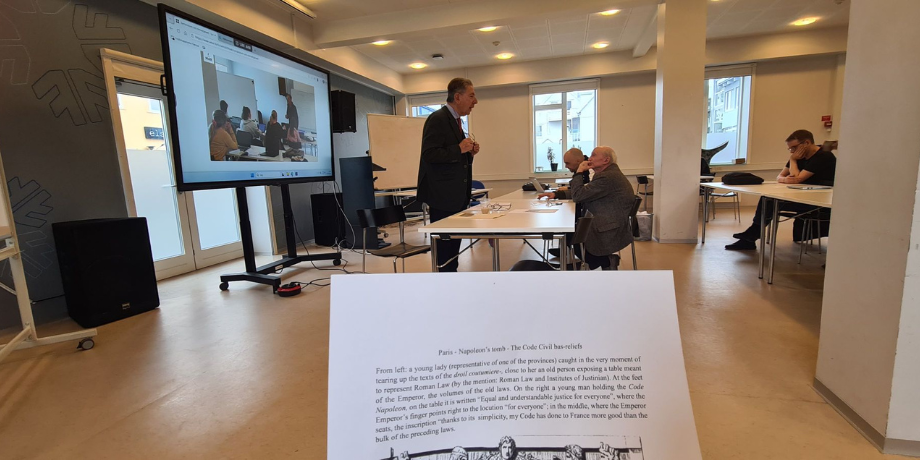
The event also featured Professor Mikael M. Karlsson, Affiliate Professor of Law at the University of the Faroe Islands since 2015, and a central figure in the development of legal education in Iceland. Before his affiliation with the Faroe Islands, he taught at the University of Iceland from 1973 until 2013, where he served as Professor of Philosophy (now Emeritus). Notably, he was seconded to the University of Akureyri between 2000 and 2004, where he acted as founding Dean of the Faculty of Law and Social Sciences, contributing to the very institutional foundations upon which UNAK’s legal education is built today.

Within this framework, Sara Fusco presented the pedagogical approach developed at UNAK in teaching Roman Law, emphasising the importance of linking historical legal reasoning with contemporary legal skills. Her approach seeks to move beyond a purely descriptive study of Roman law and instead positions it as a practical tool for training legal argumentation and critical reasoning.
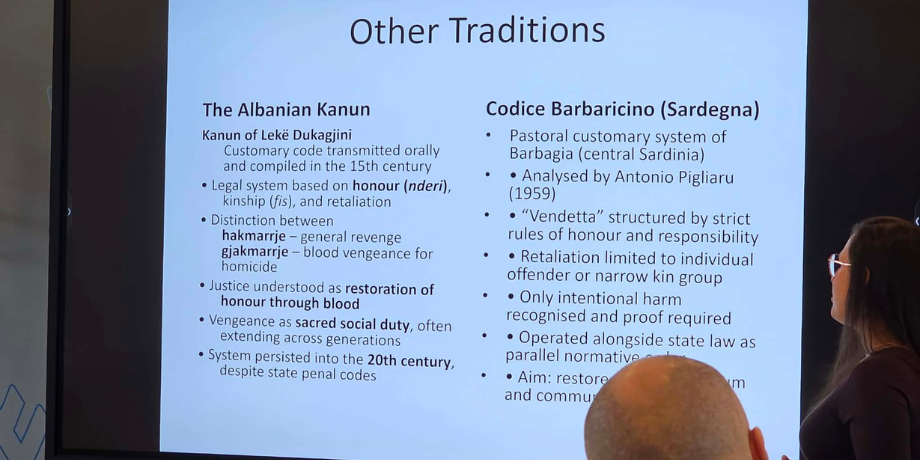
She also introduced her research on retaliation and justice in Roman and Medieval Icelandic law, drawing connections between early forms of social response to wrongdoing and broader historical patterns of legal development.
A key highlight of her presentation was the recent experience of UNAK students, who, as part of the Roman Law course, developed group research papers that were selected for publication in the academic journal Nordicum-Mediterraneum, in a special issue entitled Pax Boreo-Romana. This initiative reflects a distinctive pedagogical model that combines research-based learning with publication opportunities, encouraging students to actively contribute to academic debate.
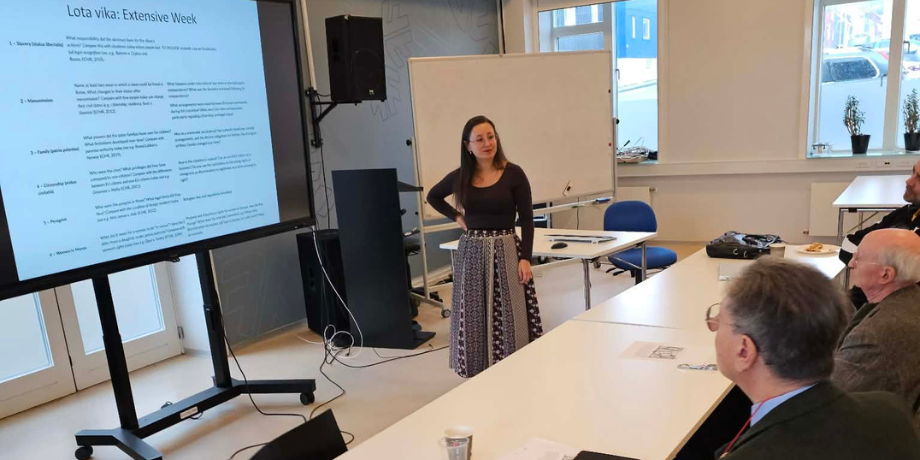
The UNAK approach to teaching Roman Law was widely praised during the symposium. In particular, its comparative dimension, linking Roman legal concepts with Nordic and Icelandic legal traditions, was recognised as an effective way to revitalise the subject and make it relevant for contemporary legal systems. Sara has explained her approaches in the Special Issue she edited for Nordicum – Mediterraneaum.
The success of the symposium has laid the groundwork for a new phase of intellectual collaboration between the University of Akureyri and the University of the Faroe Islands. Both institutions expressed interest in strengthening research ties and potentially establishing a recurring annual meeting on Roman Law, aimed at sharing both scholarly work and innovative teaching methodologies.