- Study
- Student
- Research
- About UNAK
- University
- Schools & faculties
- Governance
- Rector
- Rector’s Office
- University Council
- University Assembly
- University Office
- Laws and regulations
- Organization
- Code of Ethics
- Councils and committees
- Strategies & policies
- On campus
- Human resource
20. March 2026
UNAK representitives at Arctic Circle forum in Rome
Sara Fusco and Rachael Lorna Johnstone represent the Polar Law programme at the Arctic Circle Rome Forum
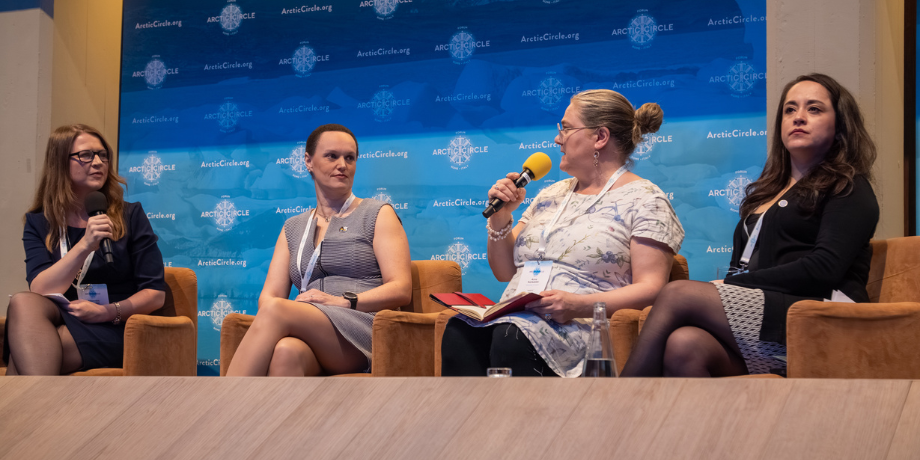
In early March, Sara Fusco and Professor Rachael Lorna Johnstone participated in the Arctic Circle Rome Forum – Polar Dialogue hosted by the Italian National Council for Research (CNR). Sara and Rachael contributed to discussions on Arctic governance, education, and security perspectives.
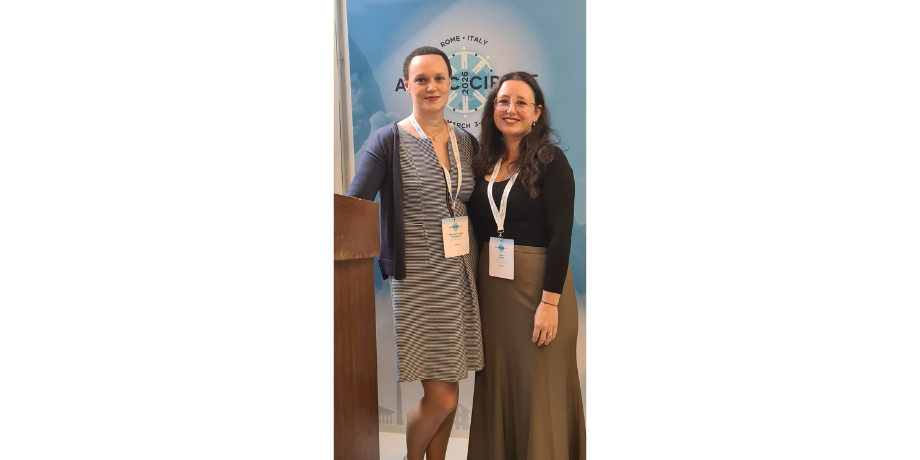
Rachael and Sara
Sara Fusco, Adjunct at the Faculty of Law and a PhD candidate at the University of Lapland, Finland, was invited by Polar Educators International to speak in the morning session. The session was titled “Bridges of the Arctic: Education and Communication”, dedicated to polar education and its broader impact on communication and academic training. In her presentation, she discussed the development of the Polar Law Programme at the University of Akureyri, outlining its origins, pedagogical approaches, and the challenges faced by students and teachers who come from non-Arctic countries.
Drawing from her own experience as both a student and now a lecturer within the programme, Sara reflected on the intellectual and personal process of acquiring polar education building on an extensive legal education from outside the Arctic region. She noted that one of the first challenges for international scholars is the unfamiliarity with many Arctic-specific legal and historical concepts, which often requires confronting one’s own national history from a new perspective. In her case, studying Indigenous rights within the Polar Law Programme led her to engage critically with the colonial dimensions of her own country’s past (Italy) an aspect she had not previously encountered in her studies.
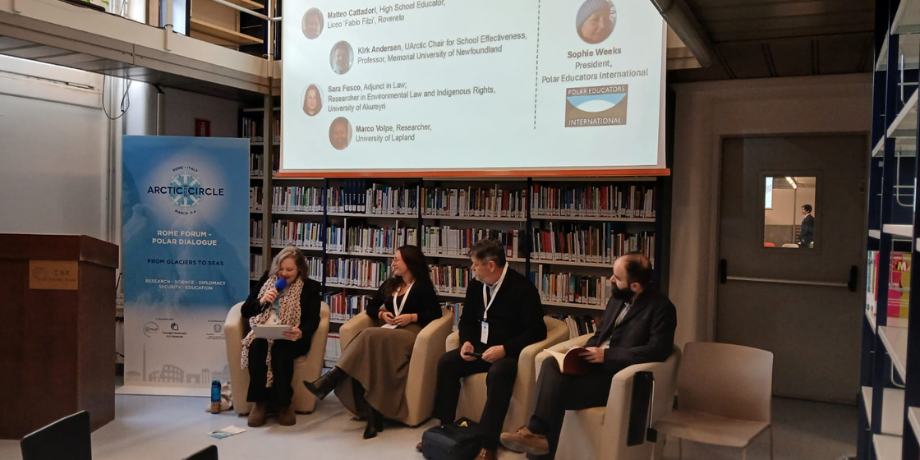
Sara in panel
Professor Johnstone presented in the panel titled “Time to Mine? Security Perspectives.” Her presentation examined the concept of “critical minerals” and questioned the political and economic assumptions behind the idea of criticality. As she explained, there is no universal list of critical minerals. Rather, different states and organisations identify them based on their own economic and strategic priorities. The label “critical” therefore reflects political choices about supply security, industrial demand, and geopolitical competition rather than an inherent property of the minerals themselves.
Professor Johnstone further explored how the discourse surrounding critical minerals is closely linked to the energy and digital transitions as well as military purposes. Minerals such as lithium, cobalt, graphite, and nickel are central to renewable energy technologies, electric vehicles, and digital infrastructure. At the same time, she emphasised that increased demand for these resources also raises questions about environmental governance, labour conditions in mining, and the protection of Indigenous rights in regions where extraction projects are proposed. Rachael was joined on the panel by fellow Fulbright Arctic Initiative IV scholars, Anna Karlsdóttir, Alexandra Middleton and Gabriela Argüello.