- Study
- Student
- Research
- About UNAK
- University
- Schools & faculties
- Governance
- Rector
- University Council
- University Assembly
- Laws and regulations
- Organization
- Councils and committees
- Strategies & policies
- On campus
- Human resource
30. April 2026
Veganestið – Lisa Pettenuzzo
Veganestið is an article series by Góðvinir UNAK, featuring interviews with graduates of the University of Akureyri
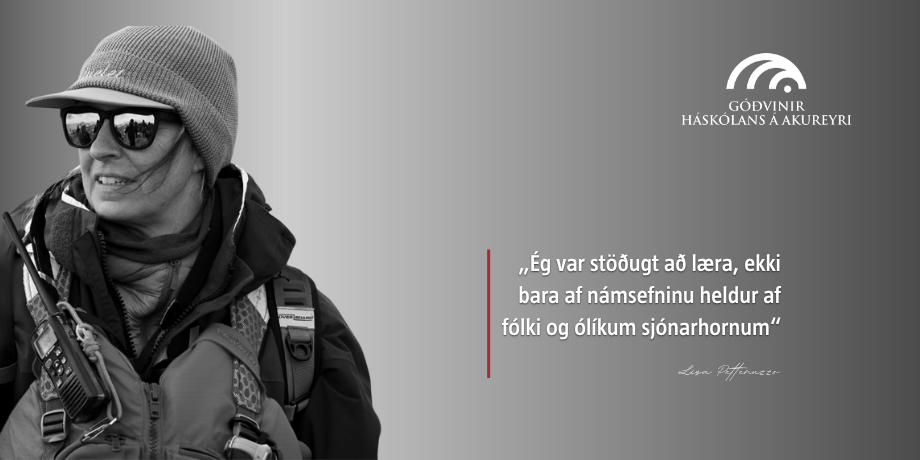
“I grew up just outside Vancouver, in British Columbia,” Lisa begins. “Nature was always close, and I think that shaped me more than I realised at the time.”
Today, she lives in a small ski town in the interior mountains of British Columbia, a place that still keeps her close to the landscapes she feels most connected to. She works as a guide on expedition ships travelling through the polar regions — a role that combines her love for nature, people, and learning.
Lisa completed a Bachelor of Arts degree at the University of British Columbia. “I studied earth sciences, social sciences, and humanities,” she says. “At the time, I didn’t think of it as a grand plan — it was just what interested me. But later I realised how important that broad foundation became.”
“I Could See the Problems — But I Couldn’t Yet Change Them”
For almost twenty years, Lisa worked in Canada’s resource extraction industry. “I spent those years working closely with Indigenous communities, and also with large corporations,” she explains. “I could clearly see how difficult it was for these groups to communicate with each other, even when they shared long-term goals like sustainability.”
She describes this gap as a chasm — one she stood close enough to observe, but not yet equipped to bridge. “With my bachelor’s degree, I felt I understood what was happening on the ground,” she says. “But I also knew that understanding wasn’t enough. I didn’t yet have the tools, or the legitimacy, to truly be part of shaping solutions.”
That realisation stayed with her, and eventually led her to search for a master’s programme that went beyond theory. “I wanted an education that would allow me to speak meaningfully in conversations involving corporations, states, and non-state actors — and to be taken seriously.”
Her search led her to Akureyri.
“Akureyri Had the Answers I Was Looking For”
“The Polar Law programme at UNAK felt like a bonanza,” Lisa says with a smile. “It is unparalleled by any other and addresses real issues that are happening right now in the circumpolar north — issues I had seen firsthand in my working life.”
Studying in Akureyri was intense, she recalls, but deeply rewarding. “The structure was demanding, but incredibly efficient. It felt like being handed centuries of amassed specialised knowledge over just two years.”
Asked to name a teacher that affected her, she named a few who shaped her experience, naming Joan Larsen, Julia Jabour, Jón Ingimundarson, Giorgio Baruchello, Demian Schane, Sólveig Guðmundsdóttir, Embla Oddsdóttir, Tom Barry, and Lassi Heininen. She gives special mention to Professor Rachael Johnstone. “Rachael is not only an extraordinary professor but has shown care and diligence in crafting this program into what it is. She is bright, astute, conscientious, a master of teaching and tirelessly available for student consultations. She is a genius in orchestration and has crafted a masterpiece in compiling professors and courses to be efficient and effective in providing us with the most prodigious expert knowledge in each field.“
„In fact, I would like to commend all the professors we have had the fortune from which to learn. ”
“When You Are Truly Exploring, You Have to Let Go”
After graduating, Lisa didn’t head down a conventional career path. “I followed my heart,” she says simply. She began working as a guide in Arctic regions, meeting people who live there and guiding travellers eager to learn.
Her time at UNAK had changed how she approached life as much as work. “When you are truly exploring, you never know what is around the corner,” she reflects. “UNAK taught me that you have to stay open — sometimes even willing to let go of your master plan.”
Stepping into the digital world in UNAK
When Lisa is asked which three words come to mind when she thinks of the University of Akureyri, she doesn’t hesitate: learning, exploring, challenge.
“Those words describe my time there perfectly,” she says. “I was constantly learning — not just from the material, but from people and perspectives. I was exploring ideas I hadn’t encountered before. And yes, I was challenged — sometimes daily.”
She laughs as she recalls arriving at UNAK as a mature student in a fully digital academic world. “My first assignment nearly defeated me,” she admits. “I had no idea what OneDrive was, and at one point , poof!, my paper simply vanished.”
There was stress, confusion, and a long night. “But I learned — and I handed it in just in time. The next day, while others were reading the Polar Law handbook, I was googling: ‘What is OneDrive?’”
It is not about right or wrong
Lisa says her studies reshaped how she understands law itself. "I grew up thinking law is about “right and wrong” and equality, fairness, and justice, and that those things are the same thing to everyone. But I learned a lot about jurisprudence during my studies. There are as many perspectives as there are humans. Law is political. Politics moves with public opinion. Public opinion changes slowly with education."
For those considering studies in this field, Lisa’s advice is simple but thoughtful: stay curious, stay open, and be prepared to have your assumptions challenged. That, she says, is often where the most meaningful learning begins.
We sincerely thank Lisa for the great conversation and wish her continued success in her work.
For those interested, more Veganesti interviews can be found on Góðvin’s Facebook page.